




You will not be allowed to compare more than 4 products at a time
View compareProduct
Blue Star Creeper Isotoma fluviatilis
Blue Star Creeper Isotoma fluviatilis
Regular price
$12.95 USD
Sale price
$12.95 USD
Regular price
Unit price
per
Shipping calculated at checkout.
SKU: P BLU STA-1
| Category | Details |
|---|---|
| Plant Type | Semi-evergreen |
| Light Requirement | Full Sun, Partial |
| Soil Condition | Dry, Well Drained, Moist |
| Bloom Season | Spring, Summer, Autumn |
| Bloom Color | Blue |
| Mature Height | 0 - 1ft |
| Growth Rate | Fast-Growing |
| Planting Zone | 5, 6, 7, 8, 9, 10 |
Sub total:
$12.95Share
Couldn't load pickup availability

Description
Planting Instructions
Shipping Information
Reviews
Description
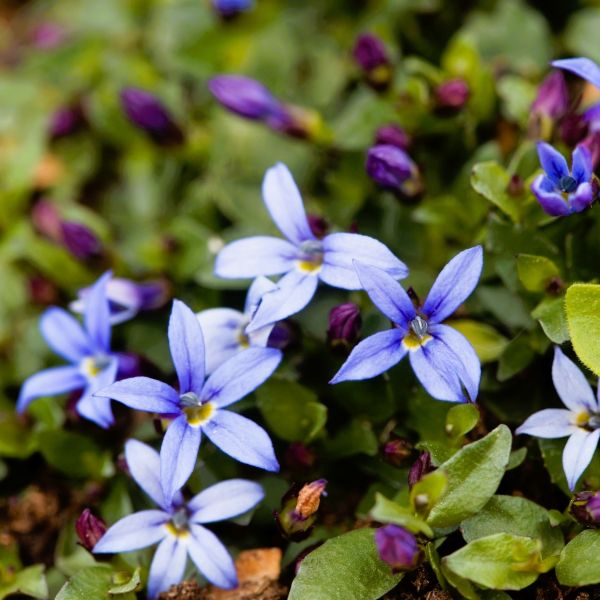
Blue Star Creeper (Isotoma fluviatilis) is one of the most charming low-growing groundcovers available — a dense, mat-forming evergreen perennial that stays just 2–3 inches tall and blooms continuously from spring through fall with tiny, delicate star-shaped light blue flowers. It fills gaps between steppingstones, softens pathway edges, and creates a whimsical, flowering carpet in rock gardens, fairy gardens, and small-space plantings where larger groundcovers won’t fit. Handles light foot traffic well. Hardy in zones 5–10.
Best for: Between steppingstones, pathway edges, rock gardens, fairy gardens, containers, under shrubs, and any small-space planting that needs long-season color and fine texture.
Why Gardeners Choose Blue Star Creeper
- Blooms spring through fall: Unlike most groundcovers that offer a single spring flush, Blue Star Creeper flowers continuously across three seasons — tiny blue stars that create a soft, constant color presence from April through October in most zones.
- Perfect scale for small spaces: At just 2–3 inches tall, it fills gaps between steppingstones, along path edges, and in tight corners that full-size groundcovers overwhelm. Its fine texture creates a delicate, refined effect that larger plants can’t replicate.
- Handles light foot traffic: One of the few flowering groundcovers that tolerates being stepped on occasionally — making it ideal for steppingstone paths and garden walkways where occasional contact is unavoidable.
- Evergreen in warmer climates: Retains foliage year-round in zones 7–10, providing green texture between bloom seasons. Semi-evergreen in zones 5–6, going partially dormant in hard winters but returning reliably in spring.
- Fast-spreading coverage: Spreads up to 18 inches wide per plant, filling gaps and problem spots relatively quickly for a plant this fine-textured.
- Versatile — sun or light shade: Performs in full sun and tolerates partial shade, making it adaptable to a wider range of garden spots than strictly sun-dependent groundcovers.
Planting & Care
- Light: Full sun to partial shade. Best bloom in full sun; tolerates dappled shade under trees or shrubs.
- Soil: Prefers well-drained to moderately moist soil. Tolerates a range of soil types but dislikes waterlogged conditions. More adaptable than most drought-tolerant groundcovers — does well in both dry and average moisture situations once established.
- Growth rate: Fast — spreads up to 18 inches wide per plant.
- Mature size: 2–3 inches tall; spreads to 18 inches wide.
- Spacing: 12–18 inches apart for pathway gaps and small-space fills; closer spacing for faster coverage.
- Watering: Regular moisture during establishment. Once rooted, moderate drought tolerance — water during extended dry spells but does not require constant moisture.
- Feeding: Light balanced fertilizer in early spring. Not heavy feeders — over-fertilizing pushes foliage at the expense of flowers.
- Pruning: Trim lightly after main spring flush to tidy edges and encourage continued bloom through summer and fall. No heavy pruning needed.
Best Uses
- Between steppingstones and flagstone paths
- Pathway and border edging
- Rock gardens and alpine plantings
- Fairy gardens and miniature garden designs
- Containers, window boxes, and hanging baskets
- Under shrubs and perennials as living mulch
- Grave site and memorial garden plantings
- Small yards and tight urban garden spaces
Grows Best In
- USDA Zones: 5–10
- Climate notes: Most at home in mild, moderate climates — thrives in the Pacific Northwest, Mid-Atlantic, South, and warm coastal regions. Evergreen year-round in zones 7–10. In zones 5–6, foliage may go partially dormant in hard winters but returns reliably. Not suited for extreme cold (zone 4 and below) or hot, arid conditions without supplemental moisture.
Problem Solved
Blue Star Creeper solves the problem of bare, awkward spaces that other plants can’t fill — the gaps between steppingstones that collect weeds, the narrow strip along a path edge that’s too tight for larger groundcovers, the corner of a rock garden that needs fine-textured color without bulk. Nothing fills those spaces with the same combination of delicacy, long bloom season, and light foot-traffic tolerance.
It’s also the go-to plant for fairy garden and small-scale decorative designs where the miniature scale of the flowers and foliage is part of the design intent.
Pro Tip
Plant Blue Star Creeper between flagstone or steppingstones with 2–4 inches of soil depth in the gaps. It will root into the gaps, knit together across the path surface, and create a living pathway that blooms all season. Pair it with Red Creeping Thyme in alternating gaps for a two-color, fragrant pathway planting that handles foot traffic and looks stunning in bloom.
Shipping Information
- Ships as container-grown plants — available in pint-size pots.
- Ships to all 48 contiguous states.
Frequently Asked Questions
Can I walk on it?
Yes — Blue Star Creeper tolerates light, occasional foot traffic, making it well-suited for steppingstone paths and garden walkways where occasional contact is unavoidable. It is not suited for high-traffic lawn replacement.
How long does it bloom?
Spring through fall — typically April through October in most zones. It is one of the longest-blooming groundcovers available, with small flushes of blue star-shaped flowers continuously across three seasons.
Is it truly evergreen?
Evergreen in zones 7–10 where winters are mild. Semi-evergreen in zones 5–6 — may go partially dormant in hard winters but returns reliably in spring.
How fast does it spread?
Fast — each plant spreads up to 18 inches wide. Fills steppingstone gaps within one to two growing seasons.
What pairs well with it?
Red Creeping Thyme is a natural companion — similar scale, walkable, and blooms in red-pink tones that contrast beautifully with the blue of Isotoma. Together they create a multi-color, fragrant pathway planting.
Will it work in a container?
Yes — Blue Star Creeper trails nicely over container edges and works well in mixed planters, window boxes, and hanging baskets where its fine texture and continuous bloom add long-season interest.
Planting Instructions
How Your Plants Are Shipped & Care Instructions
To ensure a seamless transition to your garden, please follow the specific steps below based on the type of plant you ordered:
📦 1. Container-Grown Plants
Our container-grown plants are shipped with fully established root systems nestled in premium potting media.
- Unpack & Water Instantly: Carefully remove the protective packaging and check the soil moisture. Give the pot a thorough watering until moisture runs out the bottom drainage holes.
- Acclimation Period: Place your container plant in a sheltered, partially shaded location for 2 to 3 days to help it recover from transit before moving it to full sun.
- Planting Depth: Plant at the exact same depth it was sitting in its shipping container, gently loosening the outer roots if they are encircling the root ball.
- Moisture Control: Keep the soil consistently damp but never soggy for the first few weeks as the roots expand.
🌱 2. Seedling & Liner Bare-Root Plants
Seedlings and liners are young, vibrant plants shipped without pots to make transit highly efficient.
- Immediate Attention: Unpack immediately upon arrival. If you cannot plant them right away, keep the roots moist and store them in a cool, shaded location out of the wind.
- Hydration First: Soak the roots in a bucket of water for 1 to 2 hours right before planting to wake them up.
- Planting: Spread the roots out naturally in the planting hole. Ensure the crown (where the roots meet the stem) sits right at the soil level. Water thoroughly to settle the soil around the roots.
🌾 3. Groundcover Bare-Root Plants
Groundcover bare-root bundles (like Vinca minor or Sedum) are shipped dormant or semi-dormant, ready to take off once in the ground.
- Check Moisture: Open the bundle immediately. The packing material around the roots should be damp. If planting is delayed a day or two, lightly mist the roots to keep them from drying out.
- Soak Before Planting: Soak the root systems in water for about an hour before putting them in the ground.
- Spacing & Depth: Plant them at the same depth they were growing previously, firming the soil gently over the roots to eliminate any air pockets. Water heavily right after planting and keep the area consistently moist until established.
Shipping Information
Orders containing only hard goods generally ship right away
as the inventory allows. Those items ship year-round and generally within one
week.
When ordering plants during fall or spring shipping, we will
set your order for the next available shipping week appropriate for your
location. April and May are our busiest months, and sometimes shipping delays
happen. Plants may be processed later than scheduled or the shipping department may get behind. This is not the norm, but it does sometimes happen. Please bear with us if this happens.
Our bare-root (field-grown) trees and shrubs typically arrive at the facility for shipping in November, December, and January (for fall shipping) and in February, March, April, and May (for spring shipping).
An example of month-by-month shipping would be as follows, as plants are available:
January - zones 9 - 10
February - zones 8 - 10
March - zones 7 - 10
April - zones 6 - 10
May - zones 5 - 9
June - zones 3 - 8
July - zones 3 - 7
August - zones 4 - 7
September - zones 5 - 8
October - zones 5 (some areas) - 9
November - zones 6 (some areas) - 10
December - zones 8 - 10