




You will not be allowed to compare more than 4 products at a time
View compareProduct
Ajuga Blueberry Muffin
Ajuga Blueberry Muffin
Regular price
$12.95 USD
Sale price
$12.95 USD
Regular price
Unit price
per
Shipping calculated at checkout.
SKU: AJU BLU MUF PIN-1
| Category | Details |
|---|---|
| Plant Type | Evergreen |
| Light Requirement | Partial, Full Shade |
| Soil Condition | Well Drained |
| Bloom Season | Summer |
| Bloom Color | Blue |
| Mature Height | 0 - 1ft |
| Growth Rate | Fast-Growing |
| Planting Zone | 5, 6, 7, 8, 9 |
Sub total:
$12.95Share
Couldn't load pickup availability


Description
Planting Instructions
Shipping Information
Reviews
Description
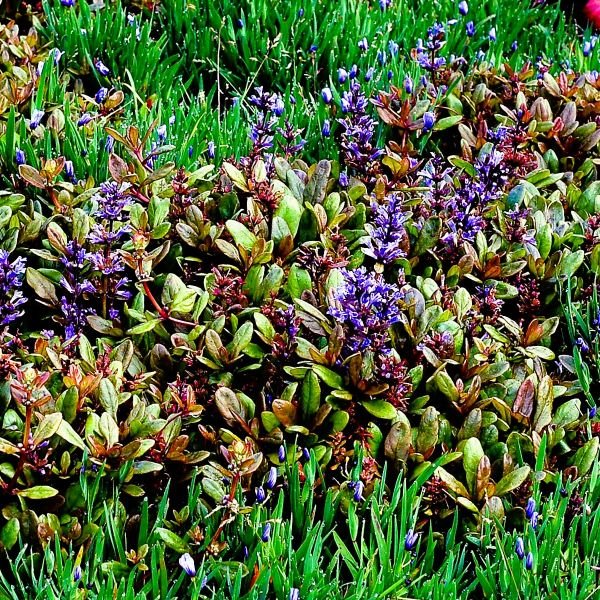
Ajuga ‘Blueberry Muffin’ (Carpet Bugle) is a vigorous, fast-spreading evergreen groundcover with some of the most vivid blue flower spikes in the Ajuga family — a low-growing perennial that forms a dense, lush mat of rich green foliage just 3–4 inches tall, erupting in spring with upright blueberry-blue flower spikes that reach 6–8 inches. Spreads to 24–28 inches wide per plant, filling in quickly to create a continuous weed-suppressing carpet that performs in partial sun to full shade. Evergreen in most zones, deer-resistant, and almost entirely maintenance-free once established. Hardy in zones 5–9.
Best for: Shade and partial-shade groundcover, slopes and banks, under trees and shrubs, shaded border edges, fairy gardens, rock gardens, containers, and any area needing fast-spreading evergreen coverage with exceptional spring bloom color.
Why Gardeners Choose Ajuga ‘Blueberry Muffin’
- Exceptionally vivid blue flower spikes: The defining feature of ‘Blueberry Muffin’ is the intensity of the flower color — a deep, saturated blueberry-blue that is noticeably richer than standard Ajuga reptans selections. Spikes rise 6–8 inches above the foliage mat in spring, creating a striking display that is especially dramatic when massed across a large planting area.
- Fast, dense spread: Spreads readily by stolons (above-ground runners), rooting at nodes to fill in gaps and extend coverage quickly. Plants spaced 18–24 inches apart will close in within one to two growing seasons to form a seamless mat.
- Evergreen year-round: Foliage is retained through all four seasons in zones 5–9, providing consistent green texture even in winter when surrounding deciduous plants are bare. One of the most reliably evergreen groundcovers for shaded areas.
- Outstanding weed suppression: The dense, low mat effectively blocks weed germination once established, significantly reducing long-term maintenance in difficult shaded areas.
- Deer resistant: Naturally deer-resistant — a significant advantage for shaded gardens and woodland edges where deer pressure is a concern.
- Drought-tolerant in shade once established: Handles dry shade conditions that challenge most groundcovers. Established plants are remarkably self-sufficient under tree canopy.
- Pollinator-friendly bloom: Spring flower spikes attract bees and early pollinators, adding ecological value to the groundcover planting.
Planting & Care
- Light: Partial sun to full shade. Most vigorous and floriferous with 2–4 hours of sun; tolerates deep shade under deciduous trees. In zones 5–6, handles more sun with adequate moisture.
- Soil: Prefers average to moderately moist, well-drained soil. Avoid consistently waterlogged conditions — crown rot can occur in poorly drained sites. Adapts to average garden soil without amendment.
- Growth rate: Fast-spreading by stolons.
- Mature size: 3–4 inches tall in foliage; 6–8 inches in bloom; spreads 24–28 inches wide per plant.
- Spacing: 18–24 inches apart for coverage that closes in within 1–2 seasons.
- Watering: Moderate moisture during establishment. Once rooted, handles dry shade well — water only during extended dry spells.
- Feeding: Not required. Thrives in average soil without supplemental fertilization.
- Pruning: Trim runners or edges as needed to manage spread and keep out of lawns or adjacent beds. Shear lightly after bloom if desired to tidy the mat. No other maintenance required.
Best Uses
- Shade and partial-shade groundcover under trees and shrubs
- Slopes and banks — erosion control in shaded areas
- Shaded border edges and bed fill
- Lawn-free and low-maintenance yard designs
- Rock gardens and fairy garden plantings
- Containers and shaded planters
- Pollinator and butterfly garden plantings
- Grave site plantings requiring low-maintenance evergreen coverage
Grows Best In
- USDA Zones: 5–9
- Climate notes: Broadly adaptable across the Eastern, Midwestern, and Southern US. Evergreen year-round in zones 6–9; semi-evergreen in zone 5 where harsh winters may cause some foliage browning. Returns reliably in spring. Not suited for zone 4 and colder without winter protection.
Problem Solved
Ajuga ‘Blueberry Muffin’ solves the persistent shaded landscape problem — bare, difficult ground under trees and shrubs where turf fails, mulch washes away on slopes, and most perennials require too much care. The dense, fast-spreading mat covers these areas permanently with evergreen foliage, year-round weed suppression, and exceptional spring bloom color, with almost no ongoing maintenance once established.
It also delivers something most shade groundcovers cannot: genuine seasonal flower color that is bold enough to be a design feature, not just a background. For a mixed Ajuga planting with contrasting foliage, pair with Ajuga ‘Burgundy Glow’ — its tricolor white, pink, and green foliage provides striking contrast to the rich green of ‘Blueberry Muffin’ while blooming in the same blue-purple tones.
Pro Tip
For the most dramatic spring bloom display, mass ‘Blueberry Muffin’ in groups of 6 or more across a shaded slope or bed — when all plants spike simultaneously in spring, the effect is a solid carpet of blueberry-blue that is impossible to miss. Mix with Mahogany Ajuga for a two-tone foliage tapestry that provides year-round contrast between the rich green of ‘Blueberry Muffin’ and the deep mahogany-bronze of the companion — both blooming in complementary blue-purple tones in spring.
Shipping Information
- Ships as container-grown plants — available in pint and quart pots.
- Ships to all 48 contiguous states with no restrictions.
Frequently Asked Questions
How is ‘Blueberry Muffin’ different from standard Ajuga reptans?
‘Blueberry Muffin’ is selected for deeper, more saturated blue flower color than standard species types and has a vigorous, dense spreading habit. The flower intensity is its defining characteristic — noticeably richer than most Ajuga selections.
Will it spread out of control?
Ajuga spreads by surface runners (stolons) and is easy to manage — trim runners back from lawn edges and adjacent beds as needed. It does not spread aggressively underground and is simple to control with occasional edging.
Does it stay evergreen in cold climates?
Evergreen in zones 6–9. In zone 5, foliage may bronze or partially die back in harsh winters but returns reliably in spring. In zone 4 and colder, not reliably winter-hardy without protection.
Is it safe around pets?
Ajuga is generally considered non-toxic to dogs and cats, though ingestion of any plant material in large quantities may cause mild digestive upset. Consult your veterinarian if you have specific concerns.
What Ajuga varieties pair well with ‘Blueberry Muffin’?
Ajuga ‘Burgundy Glow’ offers tricolor foliage (white, pink, green) for striking contrast, while Mahogany Ajuga adds deep bronze-mahogany tones — both bloom in complementary blue-purple and integrate naturally with ‘Blueberry Muffin’ in a mixed planting.
Related Collections
Planting Instructions
How Your Plants Are Shipped & Care Instructions
To ensure a seamless transition to your garden, please follow the specific steps below based on the type of plant you ordered:
📦 1. Container-Grown Plants
Our container-grown plants are shipped with fully established root systems nestled in premium potting media.
- Unpack & Water Instantly: Carefully remove the protective packaging and check the soil moisture. Give the pot a thorough watering until moisture runs out the bottom drainage holes.
- Acclimation Period: Place your container plant in a sheltered, partially shaded location for 2 to 3 days to help it recover from transit before moving it to full sun.
- Planting Depth: Plant at the exact same depth it was sitting in its shipping container, gently loosening the outer roots if they are encircling the root ball.
- Moisture Control: Keep the soil consistently damp but never soggy for the first few weeks as the roots expand.
🌱 2. Seedling & Liner Bare-Root Plants
Seedlings and liners are young, vibrant plants shipped without pots to make transit highly efficient.
- Immediate Attention: Unpack immediately upon arrival. If you cannot plant them right away, keep the roots moist and store them in a cool, shaded location out of the wind.
- Hydration First: Soak the roots in a bucket of water for 1 to 2 hours right before planting to wake them up.
- Planting: Spread the roots out naturally in the planting hole. Ensure the crown (where the roots meet the stem) sits right at the soil level. Water thoroughly to settle the soil around the roots.
🌾 3. Groundcover Bare-Root Plants
Groundcover bare-root bundles (like Vinca minor or Sedum) are shipped dormant or semi-dormant, ready to take off once in the ground.
- Check Moisture: Open the bundle immediately. The packing material around the roots should be damp. If planting is delayed a day or two, lightly mist the roots to keep them from drying out.
- Soak Before Planting: Soak the root systems in water for about an hour before putting them in the ground.
- Spacing & Depth: Plant them at the same depth they were growing previously, firming the soil gently over the roots to eliminate any air pockets. Water heavily right after planting and keep the area consistently moist until established.
Shipping Information
Orders containing only hard goods generally ship right away
as the inventory allows. Those items ship year-round and generally within one
week.
When ordering plants during fall or spring shipping, we will
set your order for the next available shipping week appropriate for your
location. April and May are our busiest months, and sometimes shipping delays
happen. Plants may be processed later than scheduled or the shipping department may get behind. This is not the norm, but it does sometimes happen. Please bear with us if this happens.
Our bare-root (field-grown) trees and shrubs typically arrive at the facility for shipping in November, December, and January (for fall shipping) and in February, March, April, and May (for spring shipping).
An example of month-by-month shipping would be as follows, as plants are available:
January - zones 9 - 10
February - zones 8 - 10
March - zones 7 - 10
April - zones 6 - 10
May - zones 5 - 9
June - zones 3 - 8
July - zones 3 - 7
August - zones 4 - 7
September - zones 5 - 8
October - zones 5 (some areas) - 9
November - zones 6 (some areas) - 10
December - zones 8 - 10