|
Home
Ferns, Our Best Value
|
Home
>
Perennials
>
Ferns, Our Best Value
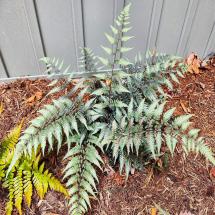
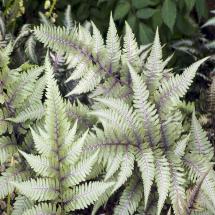
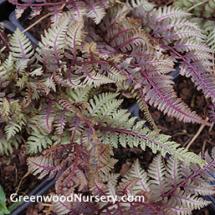
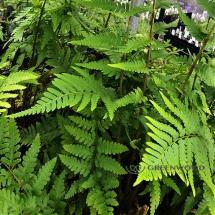
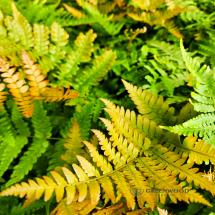
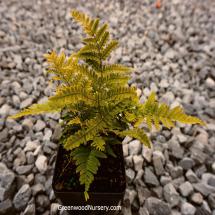
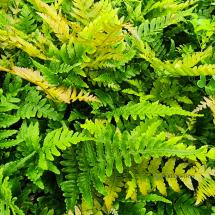
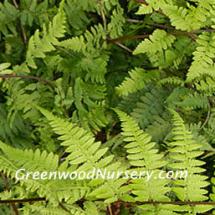
Ferns are a very ancient family of plants: early fern fossils predate the beginning of the Mesozoic era, 360 million years ago. They are older than land animals and far older than the dinosaurs. They were thriving on Earth for two hundred million years before the flowering plants evolved. Ferns add a delicate touch to the landscape. Ferns used in shaded areas, around trees, and small garden pools. Ferns die back in the winter but keep coming back year after year. Any urban landscape that contains deep shade can be improved with the planting of ferns. Ferns will grow regardless of the light requirements as long as the garden soil is rich in compost, deep, and moist. Ferns do not need much fertilizer and require very little maintenance. They are excellent companions to most shade tolerant annuals and perennials and are often used to provide contrasting texture and color. Most of the ferns spread slowly and will eventually become a ground cover of lacy fronds that are beautiful throughout the four seasons of the garden landscape. Ferns are finally becoming recognized by the nursery trade and increasing in popularity by gardeners. Some ferns have edible fiddleheads while others can grace a floral arrangement. Some have spectacular autumn color while others are evergreen and still others provide a nice cool green throughout the summer. Ferns can be used as focal points or accent plants as well as background and ground cover plants. Some do well in dry sites while others look best beside a babbling brook. All our best value, low priced ferns are #1 field grown, bare root plants, with shipping size listed on each product page. Sold in multiples of 10, and 30 plants for mass plantings.
|
|
|
|
|
Christmas Fern
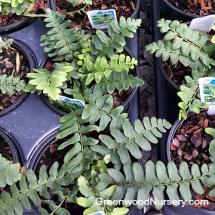
Polystichum acrostichoides or christmas fern is a hardy semi-evergreen fern that grows 2' to 3' tall and yeilds a deep, rich green color. It survives in shade and partial shade and will grow in moist or dry soil.
|
Cinnamon Fern
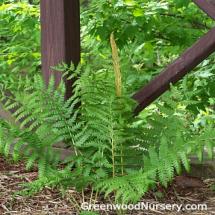
Cinnamon Fern or Osmunda cinnamomea appear similar to ostrich ferns but with some distinct differences. The crosiers of the Cinnamon Fern (young, emerging fiddlehead) are white and woolly, and it has a much larger, fertile "cinnamon stick". The Cinn
|
Lady Fern
Lady Fern, Athyrium felix-feminand, have yellow-green to medium green fronds with feathery blade pairs. The upper blades of the Lady Fern are long-tapering and ascending. Plants spread slowly to form dense clumps. Under the right conditions lady fern
|
|
|
|
|
Maidenhair Fern
Maidenhair Fern, Adiantum pedatum, are pretty and delicate. Maidenhair Fern's have wiry, purple-brown petioles and feathery, circular fronds that grow outward in a flat, fan-like position. Maidenhair Fern's are slow spreading and non-invasive.
|
Ostrich Fern
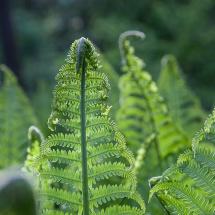
Ostrich Fern Matteuccia struthiopteris have large, dark green fronds with a vase shaped growth. Ostrich Fern is a charming tropical looking fern for specimen use.
|
Royal Fern
Royal Fern, Osmunda regalis, have very long fronds with lance-shaped leaves resembling the leaves of the ash or locust trees. Royal Fern spreads slowly, like other Osmundas, but individual plants remain. After many years large Royal Fern will be in p
|
|
|
|