


You will not be allowed to compare more than 4 products at a time
View compareProduct
Regular price
$12.95 USD
Sale price
$12.95 USD
Regular price
$15.95 USD
Unit price
per
View Shipping Rates & Delivery Info
Shipping policy
Greenwood Nursery is proud to be one of the few mail-order plant nurseries that ships year-round. We grow and ship a wide variety of plants across all seasons, including container-grown plants, bare-root ground covers, and bare-root trees and shrubs.
Our container-grown plants ship reliably throughout the year and arrive ready for immediate planting. Bare-root ground covers are carefully packaged to retain moisture in transit so they settle in quickly once planted.
For our bare-root trees and shrubs, their appearance upon arrival will naturally vary depending on the season:
- During the dormant season (typically late fall through early spring): Plants travel fully dormant without active foliage or flowers. Dormant bare-root shipping is ideal because the plants experience minimal transit stress and establish root systems rapidly once planted in early spring.
- During the active growing season (late spring through summer): Bare-root trees and shrubs are actively growing and leafed out in transit. As a result, they may show temporary transit stress upon arrival, such as leaf wilt, foliage yellowing, or leaf drop. This is a completely normal, temporary reaction and does not mean the plant is dead or damaged. When planted in soil at the proper depth (at the root collar) and watered thoroughly, the plant will focus its energy on root establishment and quickly produce fresh new foliage.
Our website reflects live inventory in real time, so anything you can add to your cart is ready for us to safely pack and ship directly to your door.
Standard transit time is 2–5 business days after your order ships, depending on your distance from McMinnville, TN. Southeast and Midwest customers typically receive orders in 2–3 days. Northeast and Pacific Northwest customers should expect closer to 4–5 days. Remember that we ship Monday through Wednesday only, so your ship date may be a few days after your order date depending on when you placed your order. You'll receive a tracking number as soon as your package leaves our facility.
SKU: VIN MIN RS 4I-1
| Category | Details |
|---|---|
| Plant Type | Evergreen |
| Light Requirement | Partial, Full Shade |
| Soil Condition | Dry, Well Drained, Moist |
| Bloom Season | Spring, Autumn |
| Bloom Color | Blue |
| Mature Height | 0 - 1ft |
| Growth Rate | Fast-Growing |
| Planting Zone | 4, 5, 6, 7, 8, 9 |
Now Booking for Spring
Sub total:
$12.95Greenwood Nursery Seasonal Planting Calendar
Seasonal Planting Calendar
Timing your planting is the secret to guaranteed root establishment. Select your region below to find the ideal windows for your trees, shrubs, perennials, and groundcovers.
1. Northeast & Mid-Atlantic (Zones 4–7)
- 🌱 Spring (Late March – May): Prime planting season. Plant dormant bare-root trees, shrubs, and hardy groundcovers as soon as the soil thaws. Container plants can go in after your final spring frost.
- ☀️ Summer (June – August): Focus on steady, deep watering. Container perennials and shrubs can still be planted, but require regular morning hydration to overcome heat.
- 🍂 Fall (September – November): The premier planting window. Warm soil and cool autumn rains stimulate deep root growth before the ground freezes, giving plants a massive head start for spring.
- ❄️ Winter (December – February): Ground is frozen. Mulch new plantings heavily to prevent frost heaving.
2. Midwest (Zones 3–6)
- 🌱 Spring (April – May): Begin planting hardy bare-root stock and shade perennials once the ground is workable and muddy spring freeze-thaw cycles settle.
- ☀️ Summer (June – August): High heat and humidity. Maintain 2–3 inches of mulch around root zones to conserve moisture. Avoid bare-root planting; stick to containers with steady irrigation.
- 🍂 Fall (September – Late October): Outstanding for deciduous shade trees, fruit trees, flowering shrubs, and cold-hardy groundcovers. Aim to finish 4–6 weeks before hard freezes.
- ❄️ Winter (November – March): Ground freezes solid. Protect young evergreens from harsh winter drying winds with mulch rings or burlap barriers.
3. Central & Transition Plains (Zones 5–7)
- 🌱 Spring (March – May): Get bare-root hedging, groundcovers, and flowering perennials in the ground early to outrun sudden early-summer heat waves.
- ☀️ Summer (June – August): High sun, wind, and dry stretches. Supplement newly planted stock with 1–2 inches of water per week.
- 🍂 Fall (September – November): The best season for root growth. Mild temperatures and autumn rains create ideal, low-stress conditions for all trees and shrubs.
- ❄️ Winter (December – February): Intermittent freezes. Plant hardy container-grown stock on mild, thaw days as long as the shovel easily penetrates the soil.
4. Southeast (Zones 7–9)
- 🌱 Spring (February – April): Plant early to take advantage of soft spring rains and moderate temperatures before extreme summer humidity sets in.
- ☀️ Summer (May – August): Intense heat stresses young root growth. Keep planting minimal; focus on deep hydration and a 3-inch layer of protective mulch.
- 🍂 Fall (September – November): The gold standard season. Warm soil allows continuous root establishment well into late autumn without top-growth stress.
- ❄️ Winter (December – February): Soil rarely freezes. Excellent for installing dormant bare-root stock, evergreen hedges, and groundcovers.
5. High-Elevation & Mountain West (Zones 3–5)
- 🌱 Spring (May – June): A short, compressed spring window. Wait until heavy snowpacks melt and soil drains before planting hardy trees, conifers, and rock-garden perennials.
- ☀️ Summer (July – August): Intense UV and drying winds require consistent moisture monitoring.
- 🍂 Fall (Late August – October): Plant early. Winter arrives fast at high altitudes—aim to get all roots in the ground at least 6–8 weeks before the ground freezes solid.
- ❄️ Winter (November – April): Extended freeze and heavy snow cover. Wrap young deciduous tree trunks to guard against sunscald and rodent damage.
6. Southwest & Arid West (Zones 8–11)
- 🌱 Spring (February – April): A short, active window to install desert-adapted perennials and drought-hardy shrubs before triple-digit temperatures arrive.
- ☀️ Summer (May – August): Avoid new plantings. Protect existing plants with shade cloth, deep drip hydration, and heavy organic mulch.
- 🍂 Fall (October – November): The primary growing season begins. Plant native trees, privacy hedges, and drought-tolerant groundcovers.
- ❄️ Winter (December – January): Warm winter soils allow continuous root development. Perfect for bare-root stock and landscape installations.
7. Pacific Northwest (Zones 7–9)
- 🌱 Spring (March – May): Extended, gentle moisture allows broadleaf evergreens, shade groundcovers, and flowering shrubs to establish naturally.
- ☀️ Summer (July – August): PNW summers are dry; keep newly planted stock watered regularly during dry intervals.
- 🍂 Fall (September – November): Prime planting season. Returning autumn rains eliminate watering chores and root stress completely.
- ❄️ Winter (December – February): Gentle maritime climate. Plant hardy shrubs, trees, and groundcovers whenever soil is workable.
Planting Tip: For microclimate guidance tailored to your specific county, consult your local cooperative extension office. We coordinate shipping schedules so your order arrives exactly when your local soil is ready for planting.
Share
Couldn't load pickup availability


Description
Planting Instructions
Shipping Information
Reviews
Description
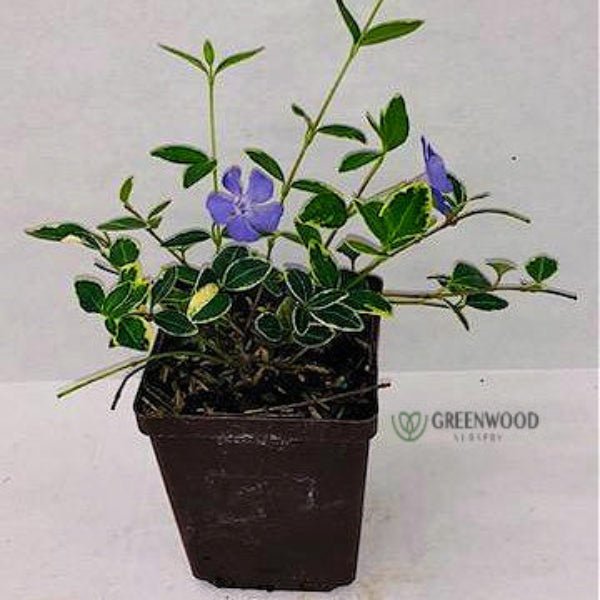
Vinca minor ‘Ralph Shugert’ is the variegated form of the classic Periwinkle groundcover — a fast-spreading, evergreen perennial with glossy dark green leaves edged in creamy white that forms a dense, low mat just 4–6 inches tall. Violet-blue flowers appear in mid-spring and again lightly in early fall, adding seasonal color to the year-round variegated foliage display. It covers ground quickly, suppresses weeds effectively, and thrives in the shaded and partially shaded areas where turf and most perennials fail. Hardy in zones 4–9.
Best for: Shaded slopes and banks, woodland gardens, under trees and shrubs, shaded border edges, containers, and any area where a fast-spreading, low-maintenance evergreen groundcover with year-round variegated interest is needed.
Why Gardeners Choose Vinca Minor ‘Ralph Shugert’
- Standout variegated foliage: The creamy white leaf margins of ‘Ralph Shugert’ set it apart from standard Vinca minor — the variegation brightens shaded areas visually and creates contrast against dark mulch, stone, and green companion plants in a way that solid-green groundcovers cannot. The effect is especially striking in deep shade where most color is lost.
- Two bloom seasons: Violet-blue flowers appear in a full flush in mid-spring and return again lightly in early fall — a bonus second season of color that few groundcovers offer. The blue blooms against the white-edged foliage are a particularly elegant combination.
- Fast coverage of difficult areas: Spreads up to 30–36 inches wide per plant and fills in quickly to create a continuous mat. Ideal for covering large shaded areas, slopes, and banks that are difficult to maintain with turf or other plantings.
- Evergreen year-round: Retains foliage through winter, providing green and white texture in the landscape when most perennials are dormant. Older leaves shed naturally in late winter as new growth pushes in — a self-renewing cycle that keeps the mat looking fresh.
- Excellent weed suppressor: The dense, interlocking mat chokes out weed germination effectively once established, significantly reducing long-term maintenance in problem areas.
- Deer resistant: Consistently rated as deer-resistant — a significant advantage for shaded garden areas where deer pressure is a concern.
- Shade and drought adaptable: Thrives in full shade to partial shade; tolerates more sun in northern climates with adequate moisture. Once established, handles dry shade conditions that challenge most groundcovers.
Planting & Care
- Light: Full shade to partial shade. Tolerates more sun in cooler northern climates (zones 4–6) with consistent moisture. Avoid intense afternoon sun in hot climates — foliage may scorch.
- Soil: Adaptable — tolerates a wide range of soil types including dry shade conditions. Prefers well-drained to moderately moist soil. Performs in average to poor soils once established.
- Growth rate: Fast — spreads 30–36 inches wide per plant.
- Mature size: 4–6 inches tall; spreads 30–36 inches wide.
- Spacing: 12–18 inches apart for groundcover coverage; 18–24 inches for a looser, more naturalistic fill.
- Watering: Moderate moisture during establishment — typically 4–8 weeks. Once rooted, low water needs and tolerates dry shade.
- Feeding: Light balanced fertilizer in early spring if desired. Not required for established plantings.
- Pruning: Trim edges as needed to control spread. Shear lightly in early spring to tidy the mat and encourage fresh, compact new growth. No heavy maintenance required.
Best Uses
- Shaded slopes and banks — erosion control under tree canopy
- Woodland and shade garden groundcover
- Underplanting beneath trees, large shrubs, and conifers
- Shaded lawn replacement and lawn-free yard designs
- Border and bed edging in shaded areas
- Containers and shaded planters where trailing variegated foliage is desired
- Coastal gardens with shade and wind exposure
- Deer-pressure areas where other groundcovers are browsed
Grows Best In
- USDA Zones: 4–9
- Climate notes: Broadly adaptable across most of the US — thrives in the Northeast, Mid-Atlantic, Southeast, Midwest, and Pacific Northwest. In cooler zones (4–6), tolerates more sun exposure. In warmer zones (7–9), shade protection is important for best foliage appearance. Evergreen year-round in most zones.
Problem Solved
Vinca minor ‘Ralph Shugert’ solves the most persistent shaded garden problem: bare, difficult ground under trees and shrubs where turf won’t grow, mulch washes away on slopes, and most perennials either fail or require too much maintenance. The dense, fast-spreading mat covers these areas permanently with year-round evergreen foliage and seasonal bloom color — and the variegated foliage adds visual brightness that solid-green groundcovers in shade simply can’t deliver.
Pair it with Vinca minor ‘Bowles’ for a two-texture, complementary planting — the variegated ‘Ralph Shugert’ brightens darker corners while the solid-green ‘Bowles’ provides a lush, classic backdrop. For deeper shade under conifers, Pachysandra terminalis is another reliable evergreen companion that handles the most challenging dry-shade conditions.
Pro Tip
For the best visual impact on a shaded slope or bank, alternate ‘Ralph Shugert’ with Vinca minor ‘Bowles’ in a staggered planting — the creamy-white-edged foliage of ‘Ralph Shugert’ against the deep solid green of ‘Bowles’ creates a layered, tapestry-like effect that reads beautifully across the slope. Both spread at similar rates, interlock naturally over time, and bloom in the same violet-blue color — a seamless combination.
Shipping Information
- Ships as container-grown plants in 3.5-inch pots.
- Ships to all 48 contiguous states.
Frequently Asked Questions
How is ‘Ralph Shugert’ different from regular Vinca minor?
The key difference is the variegated foliage — ‘Ralph Shugert’ has distinctive creamy white margins on each leaf that standard Vinca minor lacks. The growth habit, bloom color, and care requirements are the same. ‘Ralph Shugert’ is the preferred choice when you want year-round visual interest beyond the bloom season.
Will it spread aggressively?
Vinca minor is a vigorous spreader but is generally considered manageable in most landscapes — it stays low and is easy to trim back from paths and borders. Note: in some states and regions, Vinca minor is listed as invasive. Check your local guidelines before planting in natural or woodland edge areas.
Does it bloom in shade?
Yes — Vinca minor blooms reliably in partial shade. In deeper shade, bloom count may be lighter but the foliage remains evergreen and attractive year-round.
Is it deer resistant?
Yes — Vinca minor ‘Ralph Shugert’ is consistently rated as deer-resistant, which is a significant advantage for shaded garden areas in deer-pressure zones.
What pairs well with it in a shade garden?
Vinca minor ‘Bowles’ is the natural companion — same growth rate, same bloom color, complementary foliage. For deep-shade areas under conifers, Pachysandra terminalis is an excellent alternative for the most challenging dry-shade spots.
Planting Instructions
How Your Plants Are Shipped & Care Instructions
To ensure a seamless transition to your garden, please follow the specific steps below based on the type of plant you ordered:
📦 1. Container-Grown Plants
Our container-grown plants are shipped with fully established root systems nestled in premium potting media.
- Unpack & Water Instantly: Carefully remove the protective packaging and check the soil moisture. Give the pot a thorough watering until moisture runs out the bottom drainage holes.
- Acclimation Period: Place your container plant in a sheltered, partially shaded location for 2 to 3 days to help it recover from transit before moving it to full sun.
- Planting Depth: Plant at the exact same depth it was sitting in its shipping container, gently loosening the outer roots if they are encircling the root ball.
- Moisture Control: Keep the soil consistently damp but never soggy for the first few weeks as the roots expand.
🌱 2. Seedling & Liner Bare-Root Plants
Seedlings and liners are young, vibrant plants shipped without pots to make transit highly efficient.
- Immediate Attention: Unpack immediately upon arrival. If you cannot plant them right away, keep the roots moist and store them in a cool, shaded location out of the wind.
- Hydration First: Soak the roots in a bucket of water for 1 to 2 hours right before planting to wake them up.
- Planting: Spread the roots out naturally in the planting hole. Ensure the crown (where the roots meet the stem) sits right at the soil level. Water thoroughly to settle the soil around the roots.
🌾 3. Groundcover Bare-Root Plants
Groundcover bare-root bundles (like Vinca minor or Sedum) are shipped dormant or semi-dormant, ready to take off once in the ground.
- Check Moisture: Open the bundle immediately. The packing material around the roots should be damp. If planting is delayed a day or two, lightly mist the roots to keep them from drying out.
- Soak Before Planting: Soak the root systems in water for about an hour before putting them in the ground.
- Spacing & Depth: Plant them at the same depth they were growing previously, firming the soil gently over the roots to eliminate any air pockets. Water heavily right after planting and keep the area consistently moist until established.
Shipping Information
Orders containing only hard goods generally ship right away
as the inventory allows. Those items ship year-round and generally within one
week.
When ordering plants during fall or spring shipping, we will
set your order for the next available shipping week appropriate for your
location. April and May are our busiest months, and sometimes shipping delays
happen. Plants may be processed later than scheduled or the shipping department may get behind. This is not the norm, but it does sometimes happen. Please bear with us if this happens.
Our bare-root (field-grown) trees and shrubs typically arrive at the facility for shipping in November, December, and January (for fall shipping) and in February, March, April, and May (for spring shipping).
An example of month-by-month shipping would be as follows, as plants are available:
January - zones 9 - 10
February - zones 8 - 10
March - zones 7 - 10
April - zones 6 - 10
May - zones 5 - 9
June - zones 3 - 8
July - zones 3 - 7
August - zones 4 - 7
September - zones 5 - 8
October - zones 5 (some areas) - 9
November - zones 6 (some areas) - 10
December - zones 8 - 10
Reviews
- Choosing a selection results in a full page refresh.
Back to top
×
Growing Zone Information
Enter Your Zone To Find Your Growing Zone.