



You will not be allowed to compare more than 4 products at a time
View compareProduct
Thuja Green Giant
Thuja Green Giant
Regular price
$12.95 USD
Sale price
$12.95 USD
Regular price
Unit price
per
Shipping calculated at checkout.
SKU: GRE GG 2.5 PT-1
| Category | Details |
|---|---|
| Plant Type | Evergreen |
| Light Requirement | Full Sun, Partial |
| Soil Condition | Dry, Well Drained |
| Mature Height | 30 - 50 ft |
| Growth Rate | Fast-Growing |
| Planting Zone | 5, 6, 7, 8, 9 |
Sub total:
$12.95Share
Couldn't load pickup availability
Description
Planting Instructions
Shipping Information
Reviews
Description
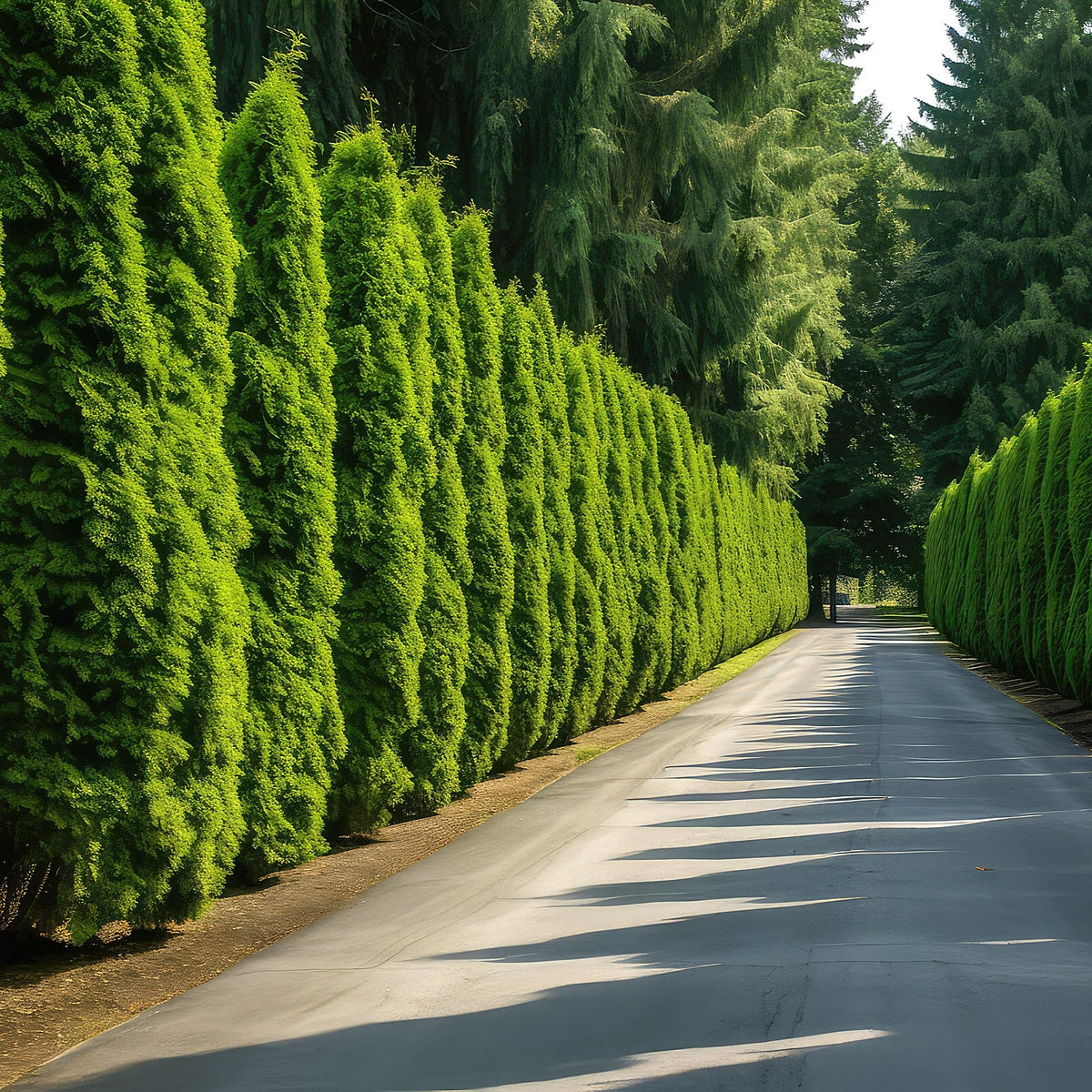
Thuja Green Giant (Thuja plicata × standishii) is the gold standard for fast privacy screening — a vigorous, disease-resistant hybrid evergreen that adds 3–5 feet of height per year and matures into a dense, naturally conical tree 30–50 feet tall. Deep green, feathery foliage stays rich and lush year-round without shearing or shaping. It outperforms Leyland Cypress on disease resistance and outlasts Hemlock in areas where woolly adelgid is a problem. Hardy in zones 5–9.
Best for: Privacy hedges, windbreaks, living fences, property boundary screening, noise reduction, and erosion control on slopes.
Why Gardeners Choose Thuja Green Giant
- Exceptional growth rate: Adds 3–5 feet per year under good conditions — one of the fastest-growing evergreen trees available, reaching effective screening height in just 3–5 years from a small liner.
- Dense, uniform screening: Naturally conical form with tight, overlapping foliage branches from ground to tip — no gaps, no browning interior, no bare legs. No shearing required to maintain shape.
- Superior disease and pest resistance: Unlike Leyland Cypress, Thuja Green Giant is highly resistant to Seiridium canker, bagworm, and spider mite damage. No serious pest or disease problems in most of its range.
- Deer resistant: Significantly less palatable to deer than arborvitae — a key advantage over American Arborvitae (Thuja occidentalis) in areas with heavy deer pressure.
- Drought-tolerant once established: Deep, fibrous root system makes it resilient to dry spells after the first growing season.
- Adaptable to soil and light: Performs in full sun to partial shade and tolerates a wide range of soil types, including clay, loam, and sandy soils, provided drainage is adequate.
Planting & Care
- Light: Full sun to partial shade. Full sun produces the densest foliage and fastest growth.
- Soil: Adaptable to most soil types. Prefers moist, well-drained soil. Tolerates clay but not standing water or prolonged saturation.
- Growth rate: Fast — 3–5 feet per year. One of the fastest privacy trees available.
- Mature size: 30–50 feet tall, 10–15 feet wide at maturity. Can reach 60+ feet in ideal conditions.
- Spacing for privacy hedge: 5–8 feet apart for a solid screen; 8–10 feet for a more open windbreak. Closer spacing fills faster but may require thinning over time.
- Watering: Water deeply and consistently for the first full growing season. Once established, very low supplemental water needs.
- Feeding: Apply a balanced slow-release fertilizer in early spring for the first 2–3 years. Not required once fully established.
- Pruning: No pruning required to maintain natural shape. Can be sheared to control width or maintain a formal hedge line — shear in late spring after new growth hardens off.
Best Uses
- Privacy hedges and living fences along property lines
- Windbreaks and shelterbelts for homes, gardens, and livestock areas
- Noise and visual buffer from roads, neighbors, and commercial areas
- Erosion control on slopes and hillsides
- Specimen or anchor planting in large landscape designs
- Wildlife habitat and nesting cover
Grows Best In
- USDA Zones: 5–9
- Climate notes: Exceptionally adaptable across a wide climate range — from the humid Southeast to the mid-Atlantic, Midwest, and Pacific Northwest. Handles summer heat, cold winters, and coastal conditions well. Not recommended for Zone 4 or colder without wind protection.
Problem Solved
Thuja Green Giant solves the most common landscaping challenge: creating a fast, permanent privacy screen without years of waiting or ongoing maintenance. It grows faster than nearly any other evergreen tree, stays dense from the ground up without shearing, and resists the diseases and pests that take out Leyland Cypress plantings.
It’s also the right choice for replacing declining Hemlock screens in the mid-Atlantic and Northeast, where woolly adelgid has devastated established hedgerows. Thuja Green Giant fills the same role with superior resilience. For a narrower columnar form suited to tighter spaces or formal hedge lines, Thuja ‘American Pillar’ is an excellent companion — both are fast-growing evergreens but ‘American Pillar’ tops out at 20–25 feet with a tighter, more columnar habit.
Pro Tip
For the fastest privacy screen establishment, plant in early spring or early fall when soil temperatures are moderate and rainfall is more reliable. Mulch the root zone 3–4 inches deep to retain moisture and suppress weeds — this single step can double first-year growth by keeping roots consistently moist during establishment. Water deeply once or twice a week rather than frequent shallow watering to encourage deep root development. For a fast-growing deciduous hedge alternative that fills in even quicker and tolerates heavier pruning, Ligustrum Ibolium North Privet is worth considering alongside Green Giant for mixed screening plantings.
Shipping Information
- Ships as container-grown plants — available in 2.5" pots, quart pots, or trade gallon containers.
- Ships to all 48 contiguous states.
Frequently Asked Questions
How fast does Thuja Green Giant actually grow?
Expect 3–5 feet per year under good conditions — full sun, adequate water during establishment, and good soil. Growth may be 1–2 feet per year in the first season while roots establish, then accelerates significantly in years 2–3.
How far apart should I plant for a privacy hedge?
5–8 feet apart for a solid screen that closes in within 3–5 years. Plant at 8–10 feet apart for a windbreak or more open screen.
Is Thuja Green Giant better than Leyland Cypress?
Yes, for most situations. Thuja Green Giant is significantly more resistant to Seiridium canker and other diseases that commonly kill Leyland Cypress plantings. It also holds its lower branches better as it matures.
Will deer eat it?
Thuja Green Giant is much more deer-resistant than American Arborvitae (Thuja occidentalis), which deer frequently browse. It’s not completely deer-proof but is rarely heavily damaged.
Does it need to be pruned?
No — it maintains a naturally dense, conical form without any shearing. You can shear it to control width or create a formal hedge, but it’s not required.
What size should I order?
Smaller liners (2.5" or quart pots) are the most cost-effective for large plantings and establish quickly. Trade gallon containers give you a head start in height. All sizes reach the same mature height — smaller sizes just take an extra season to catch up.
Related Collections
Planting Instructions
How Your Plants Are Shipped & Care Instructions
To ensure a seamless transition to your garden, please follow the specific steps below based on the type of plant you ordered:
📦 1. Container-Grown Plants
Our container-grown plants are shipped with fully established root systems nestled in premium potting media.
- Unpack & Water Instantly: Carefully remove the protective packaging and check the soil moisture. Give the pot a thorough watering until moisture runs out the bottom drainage holes.
- Acclimation Period: Place your container plant in a sheltered, partially shaded location for 2 to 3 days to help it recover from transit before moving it to full sun.
- Planting Depth: Plant at the exact same depth it was sitting in its shipping container, gently loosening the outer roots if they are encircling the root ball.
- Moisture Control: Keep the soil consistently damp but never soggy for the first few weeks as the roots expand.
🌱 2. Seedling & Liner Bare-Root Plants
Seedlings and liners are young, vibrant plants shipped without pots to make transit highly efficient.
- Immediate Attention: Unpack immediately upon arrival. If you cannot plant them right away, keep the roots moist and store them in a cool, shaded location out of the wind.
- Hydration First: Soak the roots in a bucket of water for 1 to 2 hours right before planting to wake them up.
- Planting: Spread the roots out naturally in the planting hole. Ensure the crown (where the roots meet the stem) sits right at the soil level. Water thoroughly to settle the soil around the roots.
🌾 3. Groundcover Bare-Root Plants
Groundcover bare-root bundles (like Vinca minor or Sedum) are shipped dormant or semi-dormant, ready to take off once in the ground.
- Check Moisture: Open the bundle immediately. The packing material around the roots should be damp. If planting is delayed a day or two, lightly mist the roots to keep them from drying out.
- Soak Before Planting: Soak the root systems in water for about an hour before putting them in the ground.
- Spacing & Depth: Plant them at the same depth they were growing previously, firming the soil gently over the roots to eliminate any air pockets. Water heavily right after planting and keep the area consistently moist until established.
Shipping Information
Orders containing only hard goods generally ship right away
as the inventory allows. Those items ship year-round and generally within one
week.
When ordering plants during fall or spring shipping, we will
set your order for the next available shipping week appropriate for your
location. April and May are our busiest months, and sometimes shipping delays
happen. Plants may be processed later than scheduled or the shipping department may get behind. This is not the norm, but it does sometimes happen. Please bear with us if this happens.
Our bare-root (field-grown) trees and shrubs typically arrive at the facility for shipping in November, December, and January (for fall shipping) and in February, March, April, and May (for spring shipping).
An example of month-by-month shipping would be as follows, as plants are available:
January - zones 9 - 10
February - zones 8 - 10
March - zones 7 - 10
April - zones 6 - 10
May - zones 5 - 9
June - zones 3 - 8
July - zones 3 - 7
August - zones 4 - 7
September - zones 5 - 8
October - zones 5 (some areas) - 9
November - zones 6 (some areas) - 10
December - zones 8 - 10