



You will not be allowed to compare more than 4 products at a time
View compareProduct
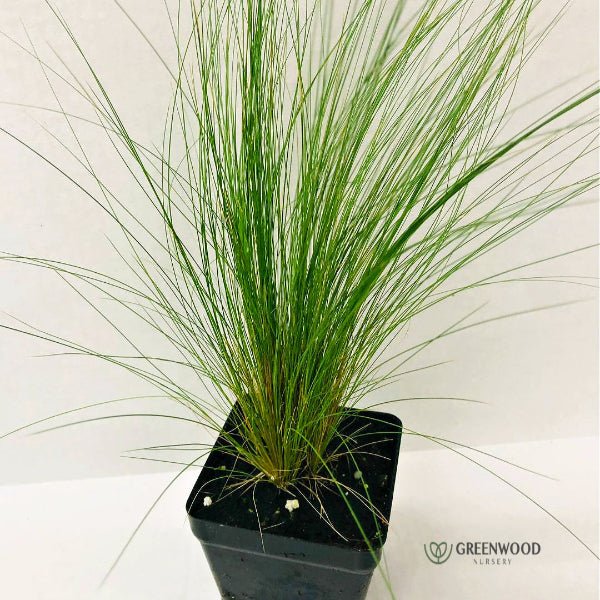
Mexican Feather Grass
Mexican Feather Grass
Regular price
$12.95 USD
Sale price
$12.95 USD
Regular price
Unit price
per
Shipping calculated at checkout.
SKU: MEX FG PI-1
| Category | Details |
|---|---|
| Plant Type | Deciduous |
| Light Requirement | Full Sun |
| Soil Condition | Well Drained |
| Bloom Season | Summer |
| Mature Height | 1 - 2ft |
| Growth Rate | Medium-growing |
| Planting Zone | 6, 7, 8, 9, 10 |
Now Booking for Spring
Sub total:
$12.95Share
Couldn't load pickup availability


Description
Planting Instructions
Shipping Information
Reviews
Description
Mexican Feather Grass (Nassella tenuissima) is one of the most graceful and visually distinctive ornamental grasses available — an airy, fine-textured perennial that forms soft, fountain-like mounds of thread-thin green blades that move constantly in the slightest breeze. As summer progresses, the foliage transitions to warm gold and honey tones and produces feathery seed plumes that shimmer and ripple with the wind, creating a soft, luminous effect that no other grass replicates. Evergreen or semi-evergreen depending on climate. Hardy in zones 6–10.
Best for: Prairie-style plantings, xeriscape and drought-tolerant landscapes, sunny borders, rock gardens, mass plantings, containers, coastal gardens, and anywhere a fine-textured, movement-driven accent is needed.
Please note: Mexican Feather Grass cannot ship to Oregon (OR) due to state agricultural regulations.
Why Gardeners Choose Mexican Feather Grass
- Unmatched movement and texture: Thread-thin blades catch even the lightest breeze and create constant, fluid motion — a living, dynamic element that photographs beautifully and brings a landscape to life in a way that static plants cannot. No other ornamental grass has quite this quality at this scale.
- Three-season interest: Soft green in spring, transitioning to golden honey tones with feathery seed plumes through summer and fall — and evergreen in zones 7–10, providing year-round texture even in mild winters.
- Exceptional drought tolerance: Once established, Mexican Feather Grass thrives on minimal water — one of the most drought-tolerant ornamental grasses available and perfectly suited for xeriscape, low-water, and water-wise landscape designs.
- Naturalizes readily: Self-seeds in ideal conditions, gradually spreading to fill sunny areas with a soft, meadow-like texture. Excellent for prairie-style and naturalistic plantings where self-seeding is welcome.
- Highly versatile: Works equally well as a single specimen accent, in mass plantings, in containers, along borders, and in coastal gardens where salt air and wind are factors.
- Native and wildlife friendly: Native to North America; seed heads provide wildlife value and the fine-textured clumps provide low-level shelter for beneficial insects.
Planting & Care
- Light: Full sun. Requires at least 6 hours of direct sun for best performance — tolerates very light partial shade but may flop or look sparse in lower light.
- Soil: Well-drained soil is essential. Thrives in poor, rocky, and sandy soils — the leaner the soil, the better. Avoid heavy clay or consistently moist sites.
- Growth rate: Medium — reaches 1–2 feet tall with a similar spread within one to two seasons.
- Mature size: 1–2 feet tall; 1–2 feet wide.
- Spacing: 18–24 inches apart for individual specimens; 12–18 inches for mass plantings to achieve a full, interlocking meadow effect.
- Watering: Water regularly during the first growing season to establish. Once rooted, extremely drought-tolerant — water only during prolonged dry spells in hot climates.
- Feeding: Little to no fertilizer needed. Excess nitrogen causes floppy, weak growth. Skip fertilizing entirely in established plantings.
- Pruning: Cut back to 3–4 inches in late winter or very early spring before new growth emerges. This annual cut keeps the clump fresh and prevents a woody, dead center from developing over time.
Best Uses
- Prairie-style and meadow garden plantings
- Xeriscape and drought-tolerant landscape designs
- Sunny borders and mixed perennial beds
- Rock gardens and alpine plantings
- Mass plantings for sweeping, wind-driven texture
- Containers and patio plantings where movement and fine texture are desired
- Coastal gardens with salt air and wind exposure
- Erosion control on dry, sunny slopes
- Native and wildlife-friendly plantings
Grows Best In
- USDA Zones: 6–10
- Climate notes: Most at home in warm, sunny, dry climates — thrives in the Southwest, Texas, California, Southeast, and Mid-Atlantic. Evergreen year-round in zones 7–10. In zone 6, goes dormant in winter and returns reliably in spring. Not suited for cool, wet, or shaded conditions. Excellent performer in coastal and high-heat environments.
Problem Solved
Mexican Feather Grass solves the problem of dry, sunny areas that need year-round texture and movement without irrigation. It transforms hot, difficult spots — rocky slopes, parking strip plantings, xeriscape borders, and sun-baked beds — into soft, dynamic landscape features that move with the wind and shift color through the seasons.
It’s also the defining plant of the modern prairie-style planting — nothing else creates the same flowing, luminous, wind-driven effect at this scale. Mass plant it across a sunny slope or border with drought-tolerant perennials from our Ornamental Grasses collection for a low-maintenance landscape that looks better every year.
Pro Tip
Plant Mexican Feather Grass in odd-numbered groups of 3, 5, or 7 across a sunny border or slope, spacing plants 18–24 inches apart. When a breeze moves through, the entire planting ripples in unison — a visual effect that’s impossible to achieve with a single specimen. Mix with drought-tolerant perennials like salvias, echinacea, or lavender for a layered, naturalistic design that needs almost no supplemental water once established.
Shipping Information
- Ships as container-grown plants — available in pint and quart pots.
- Cannot ship to: Oregon (OR) due to state agricultural regulations.
- Ships to all other contiguous US states.
Frequently Asked Questions
Will it spread on its own?
Yes — Mexican Feather Grass self-seeds readily in ideal conditions (warm, dry, sunny sites with well-drained soil). In a naturalistic or prairie-style planting this is desirable. In a formal border, deadhead after blooming to limit self-seeding. Note: it is considered invasive in some California counties — check local regulations before planting in CA.
Is it truly evergreen?
Evergreen in zones 7–10 where winters are mild. In zone 6, it goes dormant and the foliage browns in hard winters but returns reliably in spring. Cut back in late winter regardless of zone to refresh the clump.
How drought-tolerant is it really?
Very — one of the most drought-tolerant ornamental grasses available. Once established (typically after one full growing season), it thrives with little to no supplemental irrigation in most climates. It is specifically adapted to dry, lean soil conditions.
Can I grow it in a container?
Yes — Mexican Feather Grass works well in containers. Use a well-draining potting mix, place in full sun, and allow to dry between waterings. The fine-textured, wind-driven movement is especially striking in a container on a patio or balcony.
What pairs well with it in a prairie or xeriscape planting?
Salvias, echinacea, lavender, rudbeckia, and low-growing sedums complement it well. Browse our full Ornamental Grasses collection for additional companions that share its low-water, full-sun requirements.
Planting Instructions
How Your Plants Are Shipped & Care Instructions
To ensure a seamless transition to your garden, please follow the specific steps below based on the type of plant you ordered:
📦 1. Container-Grown Plants
Our container-grown plants are shipped with fully established root systems nestled in premium potting media.
- Unpack & Water Instantly: Carefully remove the protective packaging and check the soil moisture. Give the pot a thorough watering until moisture runs out the bottom drainage holes.
- Acclimation Period: Place your container plant in a sheltered, partially shaded location for 2 to 3 days to help it recover from transit before moving it to full sun.
- Planting Depth: Plant at the exact same depth it was sitting in its shipping container, gently loosening the outer roots if they are encircling the root ball.
- Moisture Control: Keep the soil consistently damp but never soggy for the first few weeks as the roots expand.
🌱 2. Seedling & Liner Bare-Root Plants
Seedlings and liners are young, vibrant plants shipped without pots to make transit highly efficient.
- Immediate Attention: Unpack immediately upon arrival. If you cannot plant them right away, keep the roots moist and store them in a cool, shaded location out of the wind.
- Hydration First: Soak the roots in a bucket of water for 1 to 2 hours right before planting to wake them up.
- Planting: Spread the roots out naturally in the planting hole. Ensure the crown (where the roots meet the stem) sits right at the soil level. Water thoroughly to settle the soil around the roots.
🌾 3. Groundcover Bare-Root Plants
Groundcover bare-root bundles (like Vinca minor or Sedum) are shipped dormant or semi-dormant, ready to take off once in the ground.
- Check Moisture: Open the bundle immediately. The packing material around the roots should be damp. If planting is delayed a day or two, lightly mist the roots to keep them from drying out.
- Soak Before Planting: Soak the root systems in water for about an hour before putting them in the ground.
- Spacing & Depth: Plant them at the same depth they were growing previously, firming the soil gently over the roots to eliminate any air pockets. Water heavily right after planting and keep the area consistently moist until established.
Shipping Information
Orders containing only hard goods generally ship right away
as the inventory allows. Those items ship year-round and generally within one
week.
When ordering plants during fall or spring shipping, we will
set your order for the next available shipping week appropriate for your
location. April and May are our busiest months, and sometimes shipping delays
happen. Plants may be processed later than scheduled or the shipping department may get behind. This is not the norm, but it does sometimes happen. Please bear with us if this happens.
Our bare-root (field-grown) trees and shrubs typically arrive at the facility for shipping in November, December, and January (for fall shipping) and in February, March, April, and May (for spring shipping).
An example of month-by-month shipping would be as follows, as plants are available:
January - zones 9 - 10
February - zones 8 - 10
March - zones 7 - 10
April - zones 6 - 10
May - zones 5 - 9
June - zones 3 - 8
July - zones 3 - 7
August - zones 4 - 7
September - zones 5 - 8
October - zones 5 (some areas) - 9
November - zones 6 (some areas) - 10
December - zones 8 - 10